How Long Should a Walk-In Shower Panel Be? The Reverse Calculation That Gets It Right
Walk-in showers are easily one of the most requested features in modern bathroom renovations. No door to clean, no frame to date, just a clean glass panel and an open entry.
But the question we get asked more than almost any other is this:
How long should the glass panel actually be?
It sounds like a simple measurement question, but it's one of the most common things people get wrong when designing a walk-in shower. Too short and water sprays out across the bathroom floor. Too long and the entry feels cramped and awkward to step into.
The short answer is this:
Don't start by measuring the panel. Start by measuring the opening you want next to it, then work backwards.
That single change in approach is what separates a walk-in shower that works beautifully from one that's a constant source of frustration.
Why "Just Pick a Standard Size" Doesn't Work
When most people plan a walk-in shower, they start by asking what size glass panel to buy. They look at off-the-shelf options, pick the one that seems about right, and assume the entry will sort itself out.
The problem is that the panel length is dictated by a handful of variables that all interact with each other:
The position of the shower head - a wall-mounted head sprays in a different direction to a ceiling-mounted one
The angle the shower head is aimed at - a slight tilt either way changes how far the spray reaches
The slope of the floor toward the drain - steeper slopes can carry water back, gentler ones let it travel further
Where the drain is positioned - a drain close to the entry behaves very differently to one against the back wall
Every one of these factors affects how far water actually travels across the shower floor. And the panel has to be long enough to contain that spray, full stop.
A "standard" 900mm panel works in one bathroom and fails completely in another, depending on how those four variables stack up.
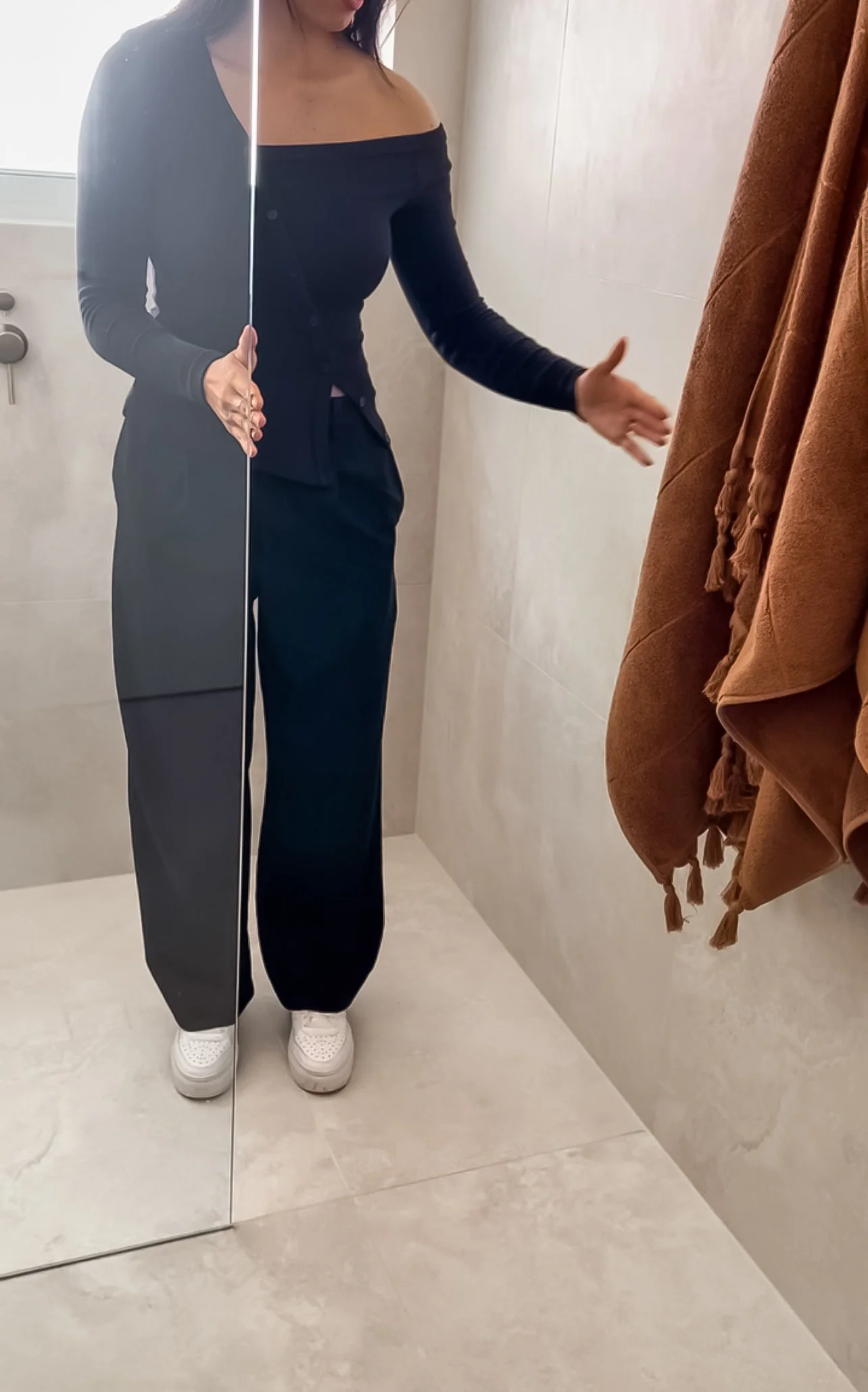
The Minimum Panel Length
As a general rule, we recommend keeping shower panels no shorter than 900mm (approx. 35.4 inches) unless the bathroom is specifically designed as a wet room.
That minimum exists for one reason. Below 900mm, even a well-designed shower with a perfectly angled head and a good floor fall will struggle to keep water inside the shower zone. You end up with damp floors outside the shower, water tracking across the room, and grout lines getting wet that were never supposed to.
A wet room is a different beast entirely. In a true wet room, the whole bathroom is waterproofed and tiled to handle water everywhere, so panel length becomes a design choice rather than a containment necessity. But for the vast majority of bathrooms, which aren't wet rooms, 900mm is the floor you don't want to drop below.
The Reverse Calculation: Start With the Opening
Here's the technique we use on every walk-in shower design.
Instead of starting with the panel and hoping the entry works out, we start with the entry and work backwards to the panel.
Step 1: Decide on your ideal opening width
The opening is the gap between the end of the glass panel and the opposite wall. This is the space you actually walk through to enter the shower.
The sweet spot is 800mm (approx. 31.5 inches). That gives a comfortable, generous entry that doesn't feel like you're squeezing in sideways.
The absolute minimum we'd ever go to is 700mm (approx. 27.6 inches). Anything narrower starts to feel awkward, particularly for anyone carrying towels, helping kids, or just stepping in and out at the end of a long day.
Step 2: Measure the total wall length
Measure the full length of the wall the shower will sit against, from the wet wall (where the tap and showerhead live) to the opposite wall.
Step 3: Subtract the opening from the total
Take the total wall length, subtract your chosen opening (ideally 800mm), and the number you're left with is the panel length you need.
For example, if the wall is 1,800mm long and you want an 800mm opening, the panel can be between 900 to 1200mm. If the wall is 2,000mm long, the panel needs to be 1,200mm.
Step 4: Match it to a stock size, or go custom
Once you've got your target panel length, find the closest stock panel size. If nothing off-the-shelf gets you close enough, a custom panel from a glazier is almost always worth the extra cost. The difference between a "near enough" stock panel and a properly sized custom one is the difference between a shower that works and one that always feels slightly off.
Why This Approach Works
Starting with the opening rather than the panel forces every other decision into line.
You end up with:
A panel that's actually long enough to contain the spray
An entry that feels generous and easy to use
A glass panel sized to the room, not the other way around
A shower that performs the way it looks like it should
Most walk-in shower problems come back to a panel that was the wrong length because nobody worked out the opening first. The reverse calculation eliminates that risk entirely.
A Few Practical Considerations
Before you finalise the panel size, there are a couple of things worth checking.
Showerhead position relative to the panel
The showerhead should always face the wet wall, never the open entry. If your design has the showerhead pointing toward the opening, even a perfectly sized panel won't stop water from escaping. Spray needs to travel into the shower zone, not out of it.
Floor fall direction
The slope of the floor should pull water away from the entry and toward the drain. If the falls run the wrong way, water will track straight out of the shower regardless of how long the panel is. This needs to be set out before screeding begins.
Lead time for custom panels
If you're going custom (and for the best results, you often will), build the lead time into your renovation schedule. Custom glass panels typically take 7 to 14 days to fabricate. Order them too late and the entire bathroom can sit waiting on a single piece of glass.
The Simple Takeaway
Here's the rule we follow on every walk-in shower design:
Don't start with the panel - start with the opening you want, ideally 800mm and never less than 700mm
Never drop below a 900mm panel unless the room is built as a true wet room
Reverse calculate - total wall length minus opening width equals panel length
Go custom if you have to, because a panel that's "near enough" is the difference between a great shower and a frustrating one
Check the shower head angle and floor falls - even the right panel can't fix water travelling the wrong direction
A walk-in shower lives or dies on these dimensions, and they're worked out in minutes if you approach them in the right order. Skip the reverse calculation and you'll be cleaning up wet floors for the next twenty years.
The real secret to a walk-in shower that actually works isn't the glass, the tiles, or the tapware. It's the few minutes of planning that gets the panel length right before anyone orders anything.
If you’re planning your bathroom renovation and want to understand where these design details fit into the bigger picture, our Bathroom Renovation Course walks you through every step from planning and design to construction and fit-off. It’s the ultimate guide to creating a functional, well-thought-out bathroom that looks great and works beautifully.
👉 Check out the course here: Manage Your Own Bathroom Renovation Course
The real secret to renovating a bathroom is not in the demolition, tiling, or styling. It is in the planning and preparation that happens first. If you want a renovation that is on time, on budget, and stress-free, put your energy into the pre-construction stage.
Get your planning right, and the build itself becomes the easiest part.
If you need help working through these decisions, our Bathroom Layout and Design Service can guide you through the options and help you create the perfect family-friendly space.